
Wheelchair elevator for stairs
The fold-down platform on a wheelchair elevator for stairs holds both rider and chair, so you do not need to move onto a seat.
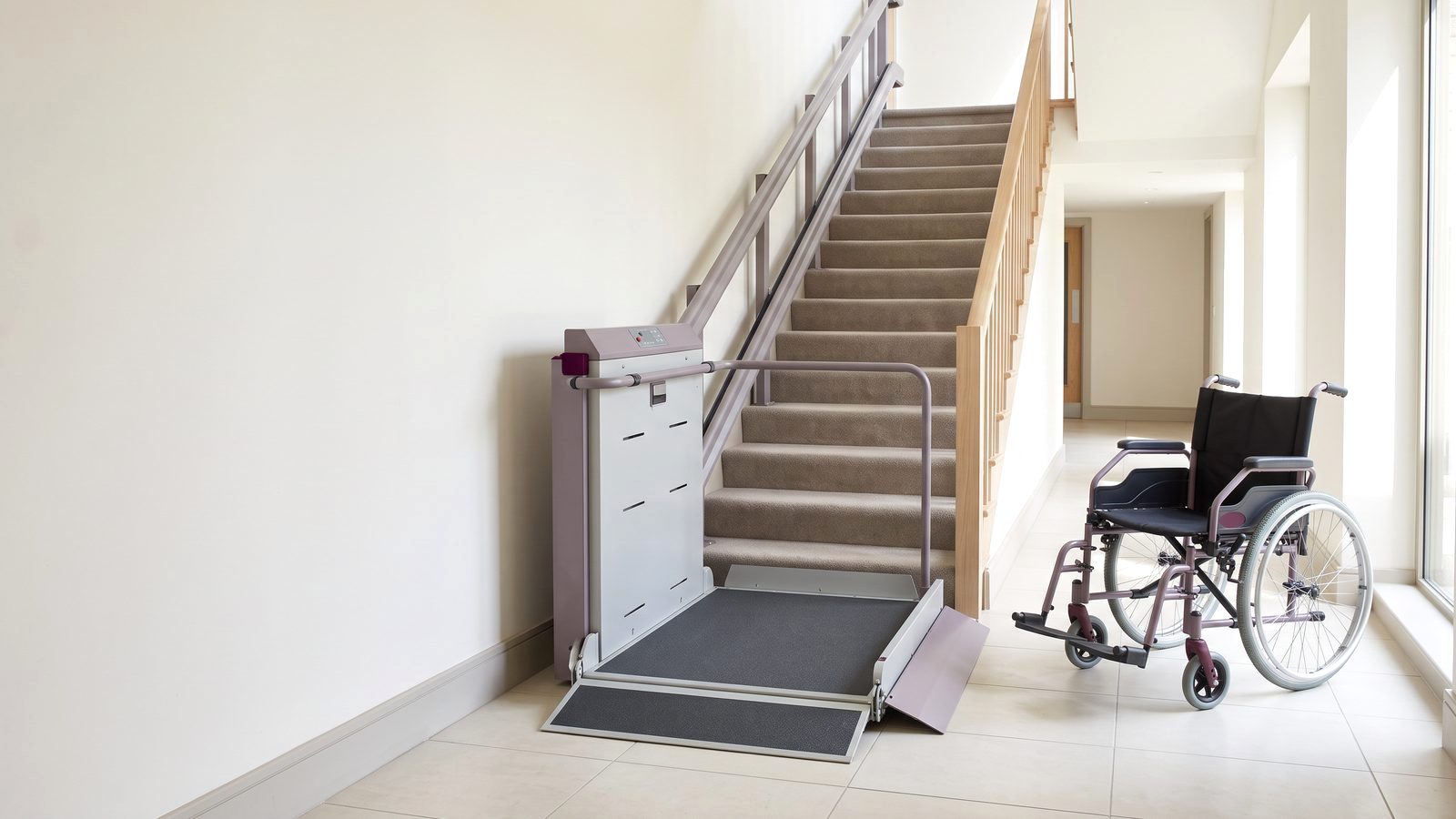
Wheelchair stair elevator options compared
| Lift | Goes over the stairs | The rider | Price, fitted |
|---|---|---|---|
| Inclined platform lift | Yes, straight or curved | Stays in a manual wheelchair | $5,000–$15,000+ |
| Vertical platform lift | No: it rises straight up beside them | Stays in any wheelchair | $12,000–$35,000 |
| Stair lift | Yes | The rider moves onto the seat, and you need a wheelchair on each floor. | $2,500–$12,000 |
Cost data comes from Lifeway Mobility and the National Council on Aging.
Inclined platform lift
A flat platform travels on a rail that matches the stair path, including any curves. When folded, it uses 10 to 13 inches of stair width (Lifeway Mobility). The weight limit is up to about 550 pounds.
Most require no concrete pad or building work. Since they carry manual wheelchairs only (Harmar), ask about power chairs before buying.
Vertical platform lift
Also known as a porch lift or mini elevator, this type goes straight up and cannot cross over stairs. Residential units rise 4 to 10 feet, hold up to 750 pounds, and need roughly 6 by 6 feet (Lifeway Mobility).
It may need a concrete pad outside, and a hoistway inside. Once permits are done, most are installed within a day.
A stair lift might be all you need.
If you can shift from your wheelchair to a seat with or without help, a stair lift is much cheaper. A second wheelchair will be needed upstairs (EZ Living). With poor balance, MS or Parkinson's, moving across is risky, so a platform is safer. Are you considering a home elevator as well? Read our comparison of stair lift vs elevator.
You should ask which lift fits your stairs.
Phone an installer nearby to inspect your stairs and wheelchair, then get quotes for both choices.